
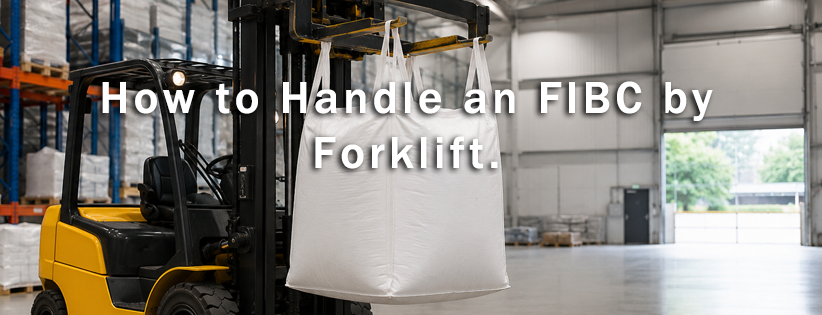
How to Handle an FIBC by Forklift
Handling an FIBC by forklift introduces its own set of risks beyond standard hoist lifting — fork placement, load balance, and lift attachment all affect whether the bag stays within its rated safe working load. Key points from this video:
Never suspend an FIBC using fewer lift loops than provided, even with a forklift boom or sling attachment. All rated loops must share the load — using a partial set concentrates stress and risks a loop or seam failure.
Use a properly rated lifting boom or sling attachment sized for your forklift and matched to the bag's safe working load — forks alone are not a substitute for a proper lifting attachment on loop-style FIBCs.
Center the load over the forks or attachment point before lifting to avoid tipping or uneven loop tension.
Lift slowly and keep the load low while transporting to maintain forklift stability, especially on uneven surfaces.
Never drive with a suspended FIBC at height — lower the load before moving the forklift any distance.
For guidance on lift loop configurations and safe working load ratings for your bags, contact our team, or explore our full FIBC bulk bag styles for the right loop and lift configuration for your equipment.
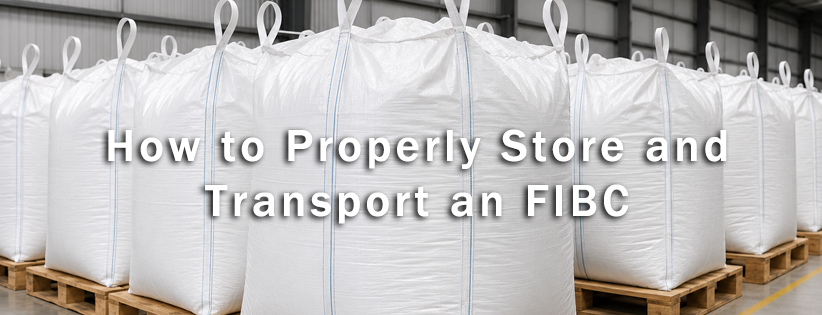
How to Properly Store and Transport an FIBC
Proper storage and transport protects both your product and your people — most FIBC storage incidents happen not during handling, but when someone approaches a bag that's already under load from bags stacked above it. This video covers the key precautions:
Never approach or repair a damaged bag without first removing all bags stacked on top of it. A damaged bag under load from stacked bags above can shift or fail unpredictably — clear the stack before doing any inspection or repair work.
Store FIBCs on a flat, stable surface capable of supporting the full stacked weight.
Stack only to the height recommended for your bag type and fill weight — over-stacking is one of the most common causes of bag failure in storage.
Keep bags away from sharp edges, forklift tines, and pallet corners that could puncture the fabric during transport or storage.
For outdoor or long-term storage, check whether your bag's fabric is UV-stabilized — unprotected woven polypropylene degrades with extended sun exposure.
Questions about stacking limits or storage duration for your specific bag type? Contact our team for specification support, or see our full range of FIBC bulk bag styles.

How to Properly Empty an FIBC
Emptying an FIBC safely takes as much care as filling it — discharge is when static charge is most likely to build up as material flows out, and rushing the process is a common cause of spills and bag damage. Key points from this video:
Beware of static discharge during emptying. The act of material flowing out of the bag generates static, so the discharge point and surrounding equipment should be properly grounded when handling static-sensitive materials.
Confirm the FIBC type is appropriate for the material being filled and discharged. A standard bag used for a static-generating powder — instead of a Type C or Type D bag — creates real risk during discharge, not just during filling.
Position the bag squarely over the discharge point before opening the spout to avoid uneven flow and spillage.
Open the discharge spout gradually rather than all at once, especially with dense or free-flowing materials, to keep flow controlled.
Inspect the discharge spout and closure hardware for wear before each use.
If you're not sure whether your current bag is rated for your material's static properties, see our Type C Conductive FIBC page or Type D Crohmiq FIBC page, or contact our team for help matching the right bag to your process.

How to Handle Static FIBC
Handling static-protective FIBCs correctly is critical when transferring flammable powders or dust in classified hazardous areas. Type C and Type D bags use different technologies to control static discharge, and mixing up their handling requirements is a real safety risk. This video covers what to watch for with each:
Type C (conductive, groundable) bags require a grounding connection at every single fill and discharge point. The bag's conductive thread grid only dissipates static safely when properly grounded — an ungrounded Type C bag offers no static protection and can be more dangerous than no protection at all.
Type D (Crohmiq, groundless) bags dissipate static automatically via controlled corona discharge — no grounding connection needed. This removes the human-error risk of a missed or faulty ground connection, which is one of the most common failure points with Type C bags in the field.
Never assume a bag's static rating — confirm Type C vs. Type D before filling, since the handling procedures are not interchangeable.
Both types are rated for Zone 1 and Zone 2 hazardous areas when handled per their respective procedures.
Not sure which anti-static bag fits your process? See our Type C Conductive FIBC page or Type D Crohmiq FIBC page for full specifications, or contact our team for help matching the right bag to your grounding infrastructure and classified area requirements.

How to Properly Fill an FIBC
Properly filling an FIBC bulk bag isn't just about efficiency — it's a safety-critical step in your handling process. This short video covers the key do's and don'ts for safe filling, including:
Never suspend an FIBC using fewer lift loops than provided. All rated loops must be used together to keep the bag within its safe working load.
Fill slowly and evenly to avoid uneven stress on the bag walls and seams.
Confirm the bag's safe working load (SWL) matches your fill weight before starting.
Inspect lift loops, seams, and the base for damage before every fill.
For bags rated for hazardous materials or requiring static protection, see our UN-Certified Hazmat FIBC page or Type C / Type D anti-static bags. Questions about the right bag for your filling process? Contact our team for specification support.
CAPRO RAFFLE GIVEAWAY!

Call us today and get connected with a packaging expert! 1-800-935-3422
How Safe is your Bulk Bag?
